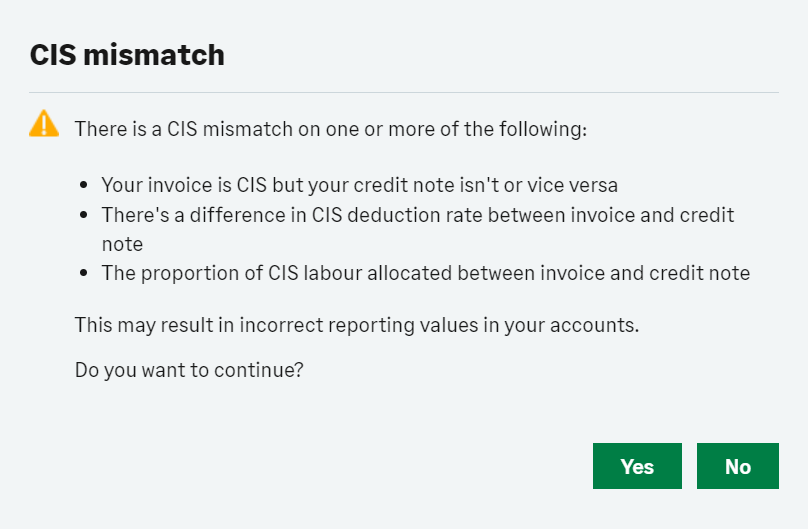
CIS mismatch error when trying to allocate invoices and credit notes
Summary
Resolution
How this works
We show you a mismatch error when:
- You try to allocate a credit note or invoice that does not have CIS deductions
- The CIS deduction rate is different between the invoice and the credit note
- The CIS labour amount differs between the invoice and the credit note
We only show CIS deductions as paid and include them on your CIS Suffered Report, when you match the invoice to a payment.
When you allocate a credit note this does not affect the Suffered report as you have not received a payment.
Where both the invoice and the credit note have CIS deductions, this is not a problem as the CIS withheld amounts offset each other.
When a credit note has no CIS deduction, the CIS amount is not offset and remains outstanding and shows on the CIS withheld category.
What to do when your subcontractor provides a non-CIS credit note
This explains what to do if your subcontractor sends your a credit note for non-CIS related work and you want to use this credit note to 'pay' an outstanding CIS invoice.
You still need to 'pay' the CIS withheld amount and make sure it is reported on your monthly return.
We recommend that you
- Record your invoice as paid in full
- Refund your credit note for the same amount and date as your invoice payment
In our example, we have a CIS invoice for £100. £30 of which is withheld, leaving an outstanding balance of £70. Rather than pay £70 to the subcontractor and wait for the subcontractor to send a refund, we want to allocate £70 from a non-CIS credit note to pay off the balance.
To do this
-
Record a payment against the outstanding amount of the invoice.
This shows the CIS withheld as paid and includes it on your monthly return.
In our example, we make a payment of £70. Although no actual money changes hands, £70 is shown against the bank account and £30 CIS amount is now reported on the CIS monthly return.
-
Record a refund against the credit note.
This should be for the same amount that was paid against the invoice, as it cancels out the payment you've just made.
In our example, we refund £70 against the credit note. The refund also shows on your bank account but cancels out the payment made against the invoice.
The CIS invoice and credit note have different deduction rates
If the deduction rate changes between recording an invoice and then recording the subsequent credit note, you will see a mismatch error when allocating the two together.
This could happen when a subcontractor issues a CIS invoice with a 20% deduction rate but the contractor is missing important information such as the UTR or the HMRC couldn't find the UTR on the list of registered subcontractors. In this circumstance, the contractor would be required by HMRC to pay the subcontractor at the 30% deduction rate.
This can be easily resolved by both parties:
As the contractor:
- Change the subcontractor's deduction rate on the supplier contacts page. Learn about CIS contacts.
- Create an invoice with HMRC's required deduction rate.
The subcontractor:
- Once aware of the deduction rate change, adds a credit note to the outstanding invoice to reverse the outstanding balance.
- Changes the deduction rate in their settings. Learn about CIS set up.
- Recreates and reissues the CIS invoice with the revised deduction rate.
If the CIS labour amount differs between the invoice and the credit note
In this scenario, rather than trying to allocate between a stand alone CIS credit note and CIS invoice with different CIS labour amounts, we recommend that you arrange to refund the stand alone CIS credit note and then add a credit note to the outstanding CIS invoice.
This is to ensure your accounts remain accurate and your CIS payments are reported correctly.
Solution Properties
- Solution ID
- 222001000100606
- Last Modified Date
- Tue Aug 15 12:38:43 UTC 2023
- Views
- 0